For many people, the biggest barrier to hair restoration is not cost or time but anxiety about the procedure itself. Lying still for several hours while local anaesthesia is applied can feel daunting. Modern hair restoration offers several ways to make the experience more comfortable, from sedation to gentler implantation tools. Knowing your options can make the decision much easier.
Why Comfort Matters in Hair Restoration
A hair transplant is performed under local anaesthesia, so patients are awake. The procedure can take most of a day, depending on the number of grafts. Anxiety can make the anaesthetic injections feel more uncomfortable and the hours feel longer. A calm, relaxed patient also makes it easier for the medical team to work steadily.
Sedation: Staying Calm Without General Anaesthesia
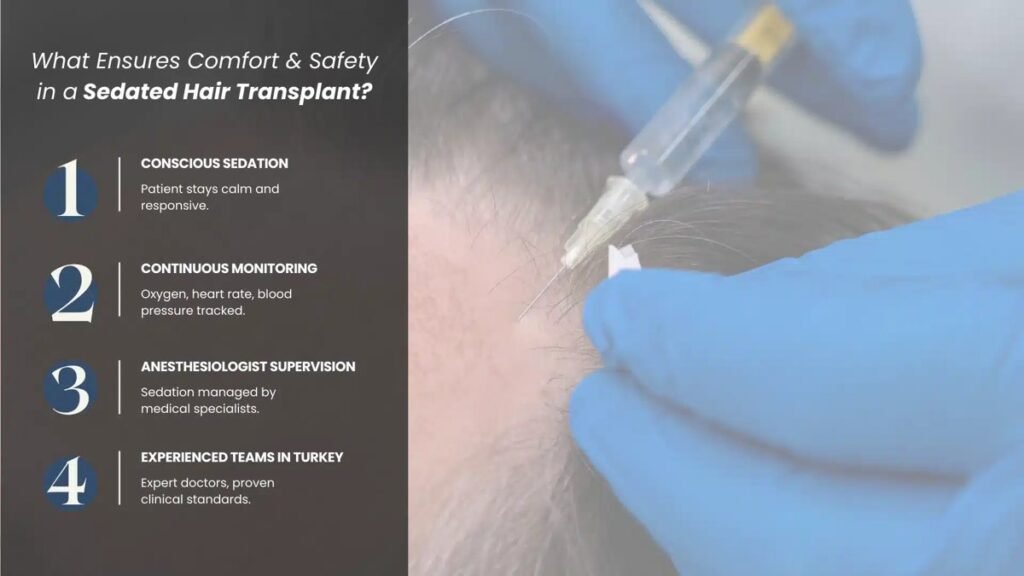
A sedated hair transplant uses conscious sedation to help patients relax. The patient remains responsive and breathes independently, but feels calmer and less aware of the local anaesthetic being applied.
What sedation involves
- a medical assessment beforehand to confirm it is suitable
- sedation managed by medical specialists
- continuous monitoring of oxygen, heart rate and blood pressure
- a short observation period afterwards before returning to the hotel
Sedation is not right for everyone. Certain health conditions and medications need to be discussed with the medical team in advance.
DHI: A Precise Implantation Method
DHI hair transplant uses an implanter pen to open the channel and place the graft in one movement. Because the angle and depth of each graft are controlled directly, DHI is often chosen for detailed hairline work and for adding density between existing hairs. It can also be used without shaving the whole head in suitable cases.
DHI compared with classic FUE
- Extraction: the same in both methods, one graft at a time.
- Implantation: DHI uses pens; classic FUE uses pre-opened channels.
- Best suited to: DHI for precision and density, FUE for larger areas.
- Time: DHI usually takes longer for the same graft count.
Restoring Hair on Scars
Scars on the scalp can come from accidents, previous surgery, burns or older transplant methods that left linear scars. Hair does not grow naturally on scar tissue, but a hair transplant on scars can often camouflage them by placing grafts directly into the scarred skin.

]
Things to know about scar treatment
- scar tissue has a weaker blood supply, so graft growth can vary
- a test session is sometimes recommended for large scars
- more than one session may be needed for full coverage
- patients prone to keloids need a careful evaluation first
Choosing the Right Combination
These approaches are not mutually exclusive. A patient with a scar near the hairline might have DHI implantation under sedation, for example. The right plan depends on your medical history, the area to be treated and how you feel about the procedure. The most important step is an honest conversation with a licensed medical team working in an authorized facility.
Conclusion
Comfort and precision have improved a great deal in hair restoration. Sedation can help anxious patients relax, DHI offers fine control over each graft, and scar treatment can restore hair where it no longer grows naturally. Understanding these options helps you choose a procedure that suits both your scalp and your peace of mind.